Laundry Powders - 2009
NOTE: information on wool washes, fabric softeners, additives, bleaches or other washing products is NOT available. We have not tested hand soaps or detergents, and we will NOT be testing shampoos or conditioners.
Welcome to the 2009 round of
laundry products testing and reporting
From a range of powder laundry detergents purchased
between September and December 2008, analysis of the wash water from those products
resulted in samples mixed for 42 front loaders and 47 top
loaders. Of those products, 18 detergents were marked as suitable for both
front and top loader and were tested for both. The results of the analysis
are presented under separate headings for each of the various components and the
comments are intended to indicate potential effects upon soil and/or plants.
Liquid laundry detergents (21) were tested for both front loader and top loader washing machines. Liquids have a low sodium and low salinity impact. Of the 21 products tested, 20 had less than 1 mg phosphorus/wash.
What was bought or sourced
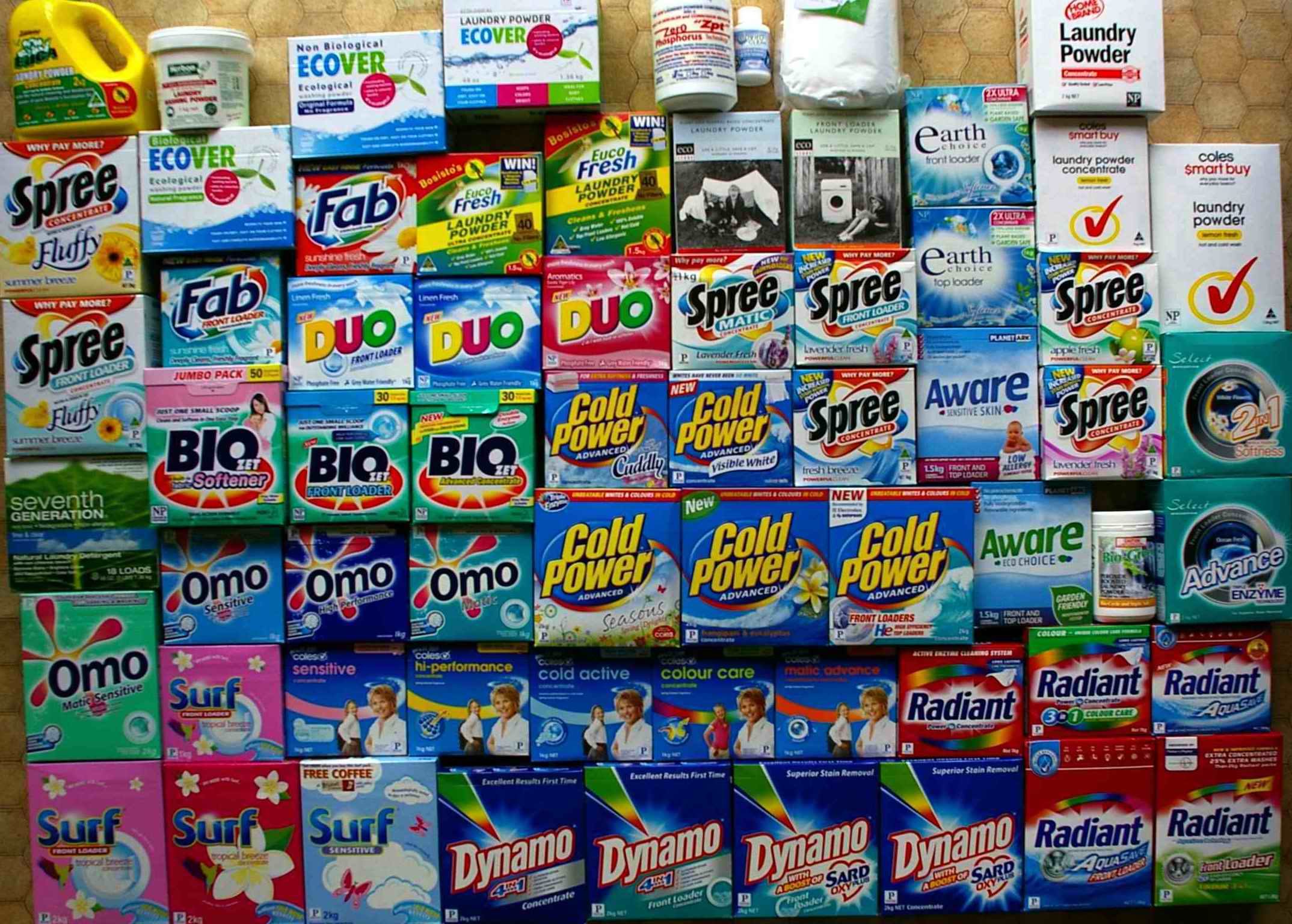
Of the 71 powder products tested, most were purchased from the three major
supermarkets in Armidale (Coles, Woolworths, IGA), and a small number of samples received from
manufacturers of boutique products with whom Lanfax Labs had contact over the last couple
of years. Unfortunately, some products were unavailable to us such as the ALDI
products because there is no ALDI store in Armidale. Several manufacturers of
non-supermarket available products declined the offer to participate. A couple
of products are absent from the photograph below because they were purchased at a later
date. An attempt was made to at least buy all the products readily available on
the supermarket shelves. Not all products were available in 1 kg packs at the
time of purchase.
All the liquids tested were provided by the respective manufacturers and tested at no cost to them.
Funding of research
This website is neither Government nor Industry sponsored.
The research is funded entirely from Lanfax Laboratories' own resources.
No funding was sought and no funding has been received from any outside source.
Those products received from manufacturers have been without charge. In
this way, Lanfax Labs seeks to be totally independent.
Don't ask: If the information isn't available in these pages, then it's because we don't have the resources to collect. But we are happy to analyse products for you - at commercial rates.
Publication of Results
The information and graphs in the following pages of this website are available
"free of charge' under the normal limitations of copyright and all copying must
acknowledge the source of the information. The use of the data for
commercial purposes is not permitted. Under no circumstances is the material to
be distributed with any proprietary item of "wastewater", "greywater" or "water
recycling" product or equipment. Lanfax Labs has no commercial interest in
any laundry product or any wastewater treatment system.
WARNING: The use of the term "Environmentally Friendly" should not be used for laundry detergents or other household cleaning agents, or soaps. Every powder and liquid carries some environmental hazard. What we need to be mindful of is which ones are "environmentally responsible" - that is, their choice provides the lowest environmental hazard to the receiving environment. In some way we are all "responsible" for our environment, so "choose to use" those with the least hazard.
Mixing the recommended rates
Each product was sampled from a freshly opened packet. Where possible, the one kilogram packet was purchased. For product
supplied by the manufacturer or retailer, at least 100 g of sample was required.
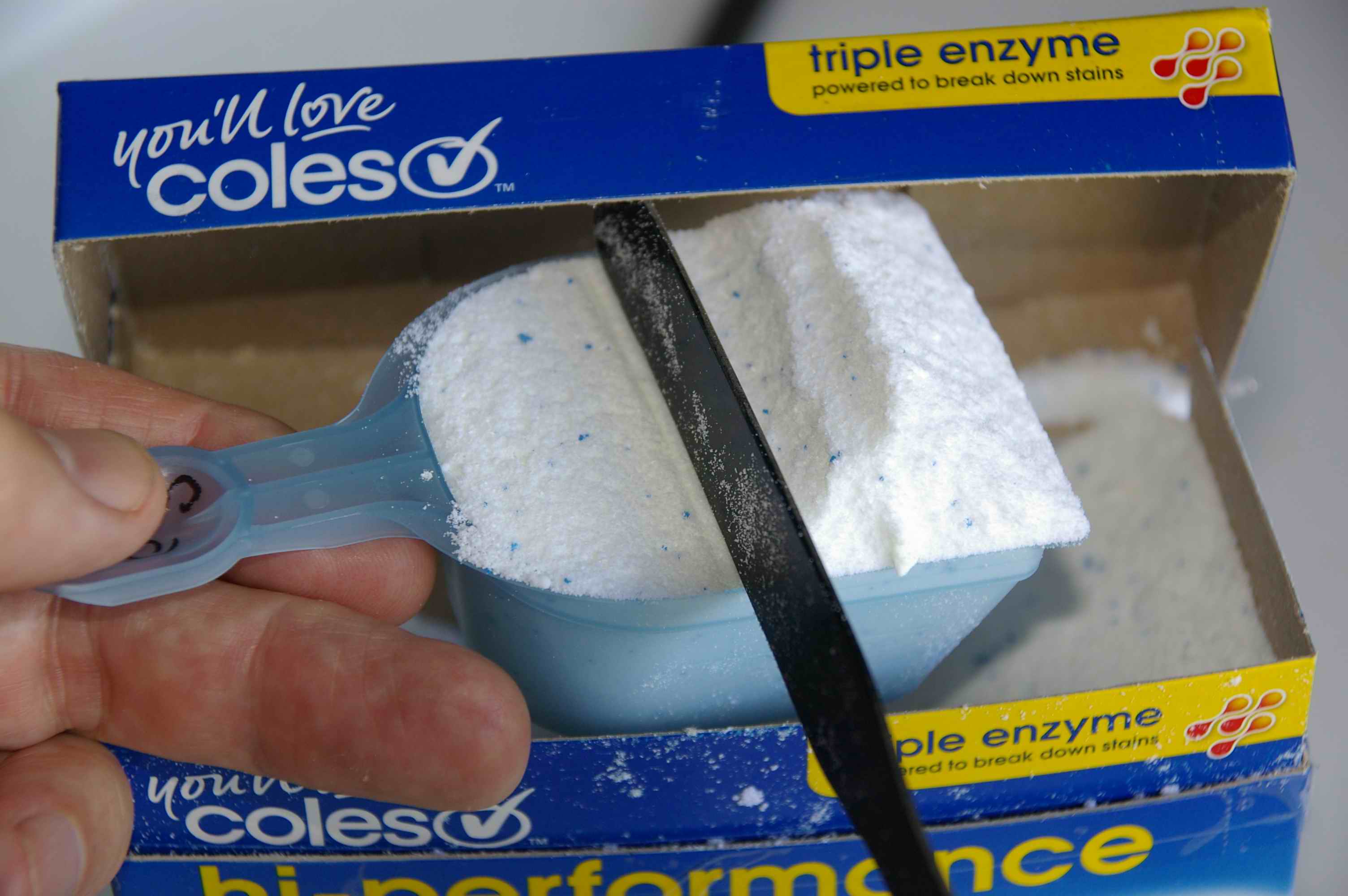 For the 71 products, nearly all came with a scoop in the
packet. That specific scoop was used to take a sample from the packet (the same
method of taking a scoop was used for all products). The scoopful of
powder (levelled to top of scoop) was poured into an aluminium dish, weighed, oven dried and a moisture analysis was
carried out to determine the amount of water in the sample. This sample was not
used for further analysis.
For the 71 products, nearly all came with a scoop in the
packet. That specific scoop was used to take a sample from the packet (the same
method of taking a scoop was used for all products). The scoopful of
powder (levelled to top of scoop) was poured into an aluminium dish, weighed, oven dried and a moisture analysis was
carried out to determine the amount of water in the sample. This sample was not
used for further analysis.
The 'as-received' weight of the sample (the weight of a scoop taken from the freshly opened packet) was used to calculate the dose (in grams) required for a "normal wash". No allowance was made for machine size, as most product labelling ignored this possible difference. An equivalent weight was then used in 500 mL of deionised water to represent the full load of the wash. The volume of the scoop was determined and used in the calculation of bulk density (mass per unit volume).
Recommended dosing rates
The manufacturers recommend load rates as part of their packet
advertising. It is assumed that these dosing rates will result in a clean
wash from a conventional top loading or front loading washing machine. The "normal wash"
rate was selected in all cases.
Some products are not recommended for front loaders, some products are specifically labelled for front loaders, and other products can be used in either front or top loaders with different dosing rates for the different machine types.
The powders were mixed at the two rates, one for front loaders (for specific front loader detergents) and for both types; and the second rate was for those unlabelled (NS) products and those for top loaders. Thus, from the graphs, one should be able to select the powder and the washing machine type of your choice.
For front loaders, the average volume of wash cycle was taken as 25 L and for top loaders the wash cycle of 60 L was assumed. Unfortunately from the WELS Scheme's website (www.waterrating.gov.au) no indication of volumes is available other than total cycle water use. The two volumes of 25 L and 60 L were taken from values used in previous research with Choice.
Analysis of wash water
The detergent sample was mixed at the estimated rate ( for
front loader, top loader or both as required) in 500 mL of deionised water
(resembling clean rainwater) and shaken in a reciprocating shaker (pictured
left) at 25oC
for 30 minutes. The fresh sample was then analysed for pH, electrical
conductivity (EC), total alkalinity and turbidity.
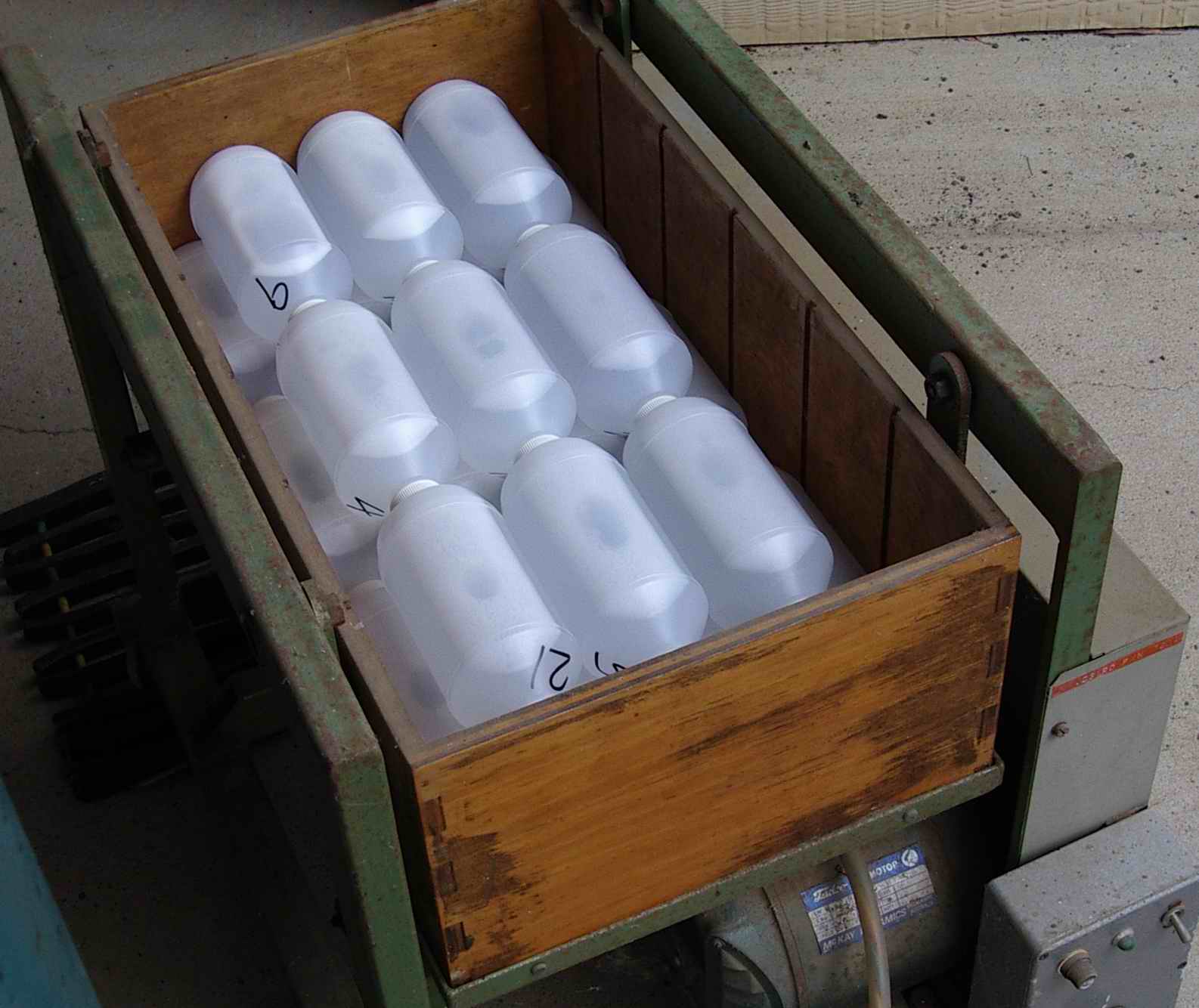
As well as turbidity, a visual inspection of the bottle was made to identify any solid particles remaining in the water. After shaking, solid particle could be seen settling to the bottom while entrained air rose to the surface.
Surprisingly, many of the samples contained undissolved solids. Of the 42 front loader samples, 24 had visible particles in suspension, while 20 of the 47 top loader samples had visible solids. The solids were not investigated but they could not be precipitates of calcium and magnesium (elements causing hardness) because the deionised water did not contain these elements. All that these solids can be are undissolved mineral, possibly zeolite where this mineral is used as a phosphorus replacement, or insolubles from reactions of the components in the powder.
Solubility of the detergents
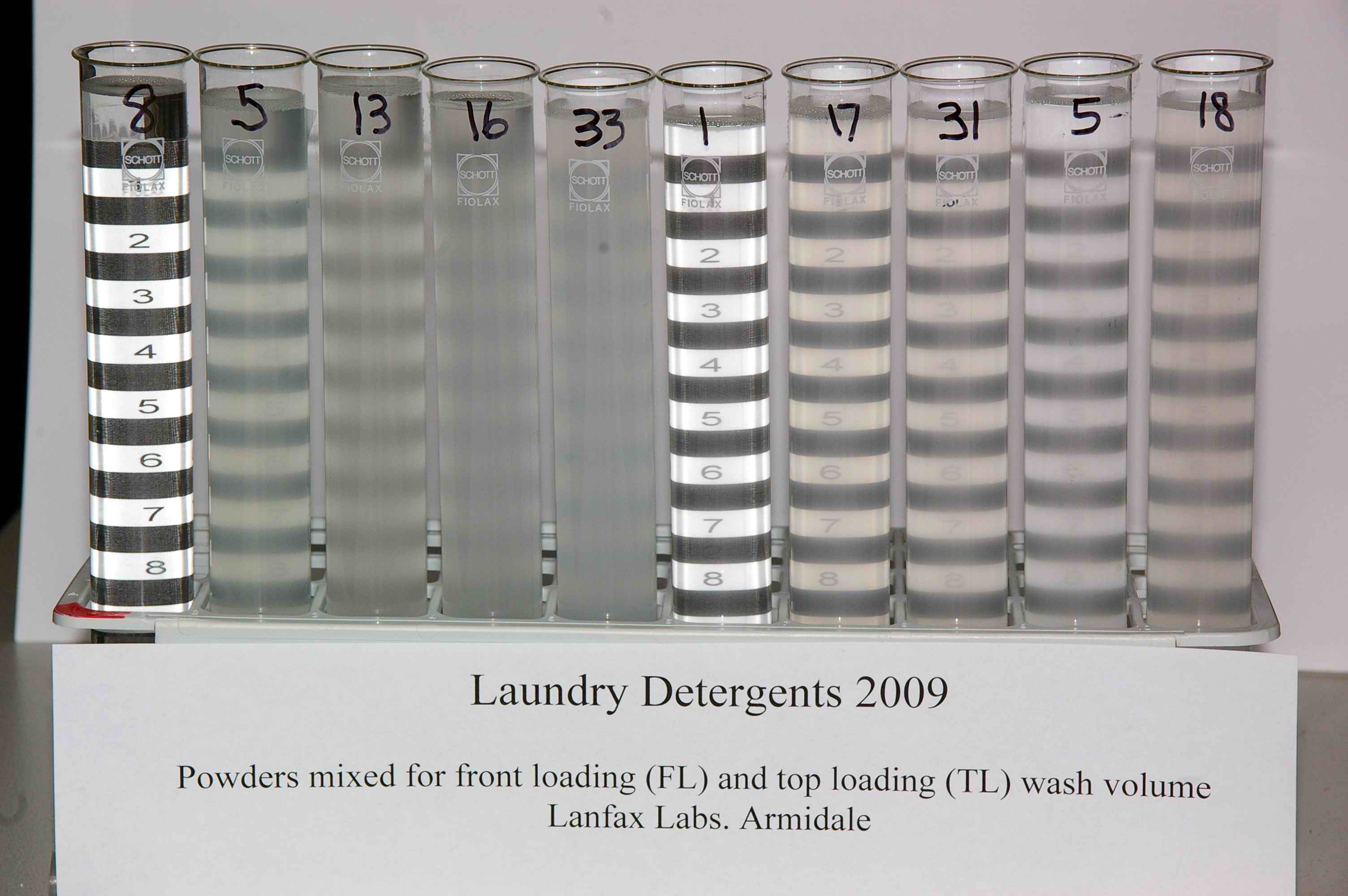
As an indicator of the various levels of turbidity
of settled samples, the figure below shows the range of turbidity for five
selected samples of front loader (from the left 1-5) and five samples of top
loader mixtures (6-10). The small black and white blocks behind the test tube
allow you to gauge the turbidity as a measure of opaqueness of the liquid - a
simple turbidity meter. These samples had been allowed to stand for 30
minutes before the photograph was taken.
Analysis of wash water
A sample of the mixed detergent was acidified to pH <2 with nitric acid, filtered through a normal filter paper
(equivalent to Whatman No.21), and the filtered sample analysed using an Inductively
Coupled Plasma (ICP) for boron, sodium, phosphorus, sulphur as well as calcium,
magnesium and potassium. The latter three elements are of only minor
importance and are not reported here. Good Laboratory Practice (GLP) was used in the
analysis of these samples. Statistical variation is within + 5%
for the sample analysed. Homogeneity of the detergents has not been assessed and
it can only be assumed that the sample provided for analysis was representative
of a larger (1 kg) packet. The results for phosphorus, sodium and sulphur were
calculated in grams per wash for the respective size machines.
Reporting
The results of all the analyses are presented as a series of
graph indicating the values recorded for each product by name. Additional
information is provided in frequency graphs, where the number of samples in each
range are reported for both front and top loading wash cycles.
Numbering System for graphs
The number system used for the graphs is as follows:
F = front loader, T = top loader,
the graphs are numbered in sequence
the last characters are the reference to the component measured pH, EC, Na (for Sodium), P (for Phosphorus), Na & P, S
(for Sulphur)
F2-EC is therefore Powder (by default) - Front
Loader - graph 2 showing electrical conductivity
Identification of products
The name used for the product has been taken from the front panel of the packet,
with sufficient information to accurately distinguish the product from all
others. Where the name is given in BLOCK letter, the powder was tested at
the front loader rate. The description FL and MATIC further
distinguish the products that are specifically for front loaders. For
example 'COLES MATIC advance' was tested only at the front loader rate. 'Radiant
Power Concentrate' was mixed at both the front loader rate and the top
loader rate.
Phosphorus Labelling
NP - no added phosphorus,
although minor amounts of phosphorus may be present from the other compounds
from which the product is made. Products with less than 0.05 g/wash were
considered to be consistent with this symbol.
P is a maximum level of 7.8 g phosphorus per wash as self-imposed by the manufacturers. The reason the level is set at 7.8 g is not clear as at this rate it equates to about 310 mg/L in a top loader wash, or 130 mg/L in a top loader wash cycle. The NSW EPA licence requirement for discharge of wastewater from a sewage treatment plant is 0.3 mg/L.
n/s No symbol or not stated - some brands had no information that could be used to determine the likely phosphorus contribution from the product.
Numbering System
The number system used for the graphs is as follows:
F = front loader, T = top loader,
the graphs are numbered in sequence pH
=1 EC = 2, Sodium = 3,
Phosphorus = 4, Na & P = 5, Sulphur = 6
the last characters are the reference to the type of graph
F2-EC is therefore Powder (by default) - Front Loader - graph 2 showing electrical conductivity
Navigating around the site
As a suggestion, the easiest way to navigate
around the site is to use the links shown in the left hand column, and the
hyperlinks within pages where they exist. We have placed the appropriate
detail where we think it will assist in understanding the graphs and
photographs. Material may be duplicated, on purpose, rather than have you
move backwards and forwards across the pages.
We have not assumed very much basic chemistry, and where appropriate have explained the terms and offered some interpretation. However, we do not make recommendations and each reader will have to weigh up the comments with the data and make an informed decision based upon their unique situation - land application area, soils, vegetation, irrigation frequency, irrigation rate, as well as the detergents used and the volume of wastewater generated.
The "Greywater" page provides much of the interpretation of the data as it relates to land application. That may be a good starting point. Then work to each of the various pages as they may be important to you.
If you are planning to buy a new washing machine, it may be of interest to browse through the "washing-machine" page before you set your sights on a front loader or a top loader. Be aware, be a vigilant consumer! Don't get caught with the 'marketing spin'. Don't get sucked in by government rebates.
NOTE: Under no circumstances is any of the information on this website to be taken as an endorsement of any product. Neither should the information be interpreted to suggest that a product does not have some worth in the laundry. The information is presented to allow purchasers to make informed decisions about the products and the potential impact upon the receiving soil environment, particularly when used for greywater reuse.
©Copyright: Lanfax Laboratories PO Box
4690 Armidale NSW 2350.
Contact: Dr Robert Patterson
+61 2 67751157 email:
lanfaxlabs@bigpond.com.au